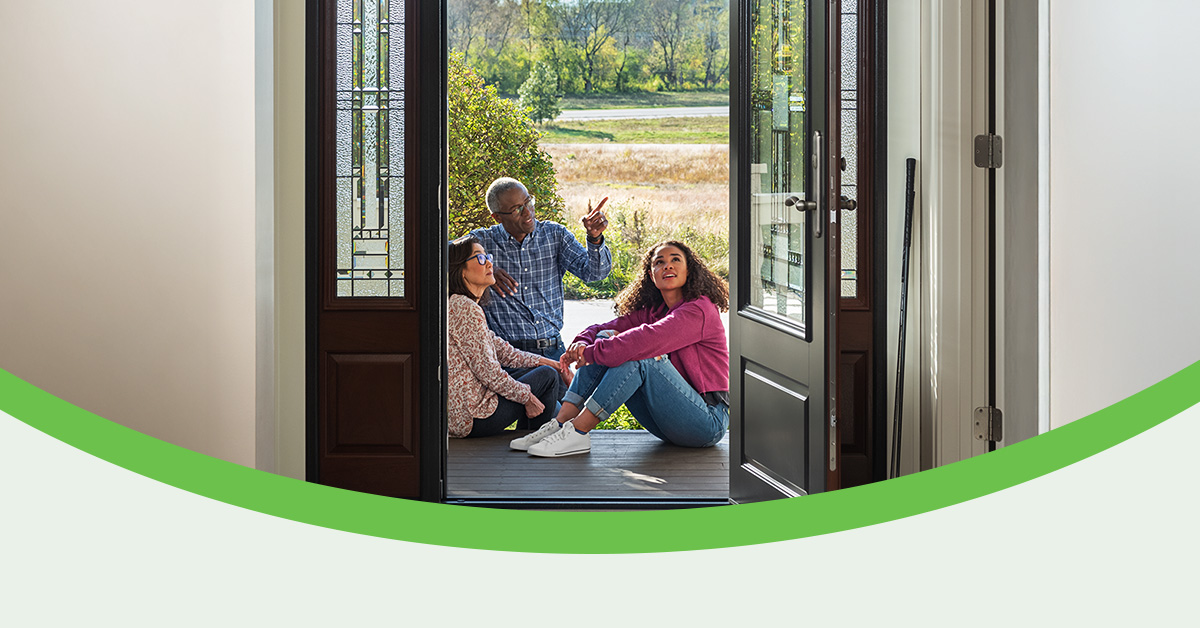
A simple way to spruce up your home is by replacing your front door. Perfect for a quick home improvement project or adding an extra decorative touch, a replacement door is just the thing to welcome you and your visitors into your home. Since the front door is the first thing you see, you want it to be beautiful, inviting and in top condition.
If it’s time to replace your front door, our guide will help you learn how to measure a door for replacement.
Before shopping for your replacement exterior door, you need to have the right measurements. That starts with gathering the right tools. Get a tape measure, a pencil and a notepad to write down each length. You also need to determine if you’ll be replacing just the door or the entire prehung door unit, including the door frame, hinges, slab and trim. Installing a new door slab is generally an easy DIY project, but replacing the entire unit may require expert assistance.
Keep in mind that doors come in different shapes and sizes, and it’s OK if your measurements differ from the standard. The standard measurements in the U.S. are:
Now, we can move on to measuring!
Start by measuring the door slab. This part of the door is the panel that opens and closes, secured with a lock mechanism. Essentially, it’s the door without the frame.
Measure all aspects of the door slab, which includes:
Ensure the tape measure is straight and taut for a precise reading. Measurements may differ if your door or frame isn’t level or straight. If you’re only replacing the door slab, you can stop your measurements here. If you’re installing a replacement prehung unit, you’ll need additional dimensions to ensure a perfect fit.
The door frame is the framework installed into the wall opening to support the door, allowing it to hang, swing and close easily.
Same as the slab, you need to measure:
For the most accurate reading, make sure your tape measure is straight and level.
This step is often overlooked when measuring for an exterior door replacement. However, the dimensions for door jambs are just as important for ensuring your door fits flush with the frame and keeps drafts and weather out.
Door jambs are the inner vertical panels of a door frame where your door is secured with hinges and a lock mechanism. There’s the hinge jamb, where the door’s hinges are mounted, and the strike jamb, where you’ll see the strike plate. This is also measured as door frame thickness.
Here’s how you measure these parts of the door:
You’ll also need to measure the door frame opening. This opening is the hole in the wall where your door frame is installed and secured, meeting the house’s brickwork.
Here’s how:

Don’t forget to include sidelight dimensions if they’re part of your prehung unit. Sidelights are the narrow vertical windows on either side of the door, used for aesthetics and bringing more light into your entryway.
Keep these measurements separate:
Sometimes, a home has one sidelight alongside its entry door, while others have none. You can adjust this calculation to suit your door and its components.
Take a moment to check whether your door is inswing or outswing. Not all door swings the same way, but if you are looking to change their direction and orientation, this needs to be noted as it affects the position of the door’s hinges and lock mechanism. To identify which way your door swings, watch its direction of travel. If you push it to enter your home, it’s an inswing door. If you need to pull the door, it’s an outswing door.
Also, consider whether it’s a right- or left-handed door by locating the hinges. If they’re on the right, it’s a right-handed door. And if they’re on the left, it’s left-handed.
These tips will help you take more accurate measurements:
Now that you have everything you need, you can shop for a door that matches your home and style.
Fitting a replacement door is more than enhancing your home’s curb appeal. It’s also about improving energy efficiency and security, and ensuring your door is wear and tear-free. And if it’s time for you to replace your old faithful, we’re here to help you.
Renewal by Andersen® offers the nation’s best window and door replacement solution, with over 30 years of experience to meet all your replacement needs. You can find us throughout North and South Carolina, in Charlotte, Greenville, Asheville, Spartanburg, Columbia, Charleston and Hilton Head.
Need help with choosing the right size, color and shape to fit your style or want more information about how to measure for your new door? Contact us today for a free consultation with expert designers to bring your aesthetic vision to life.